

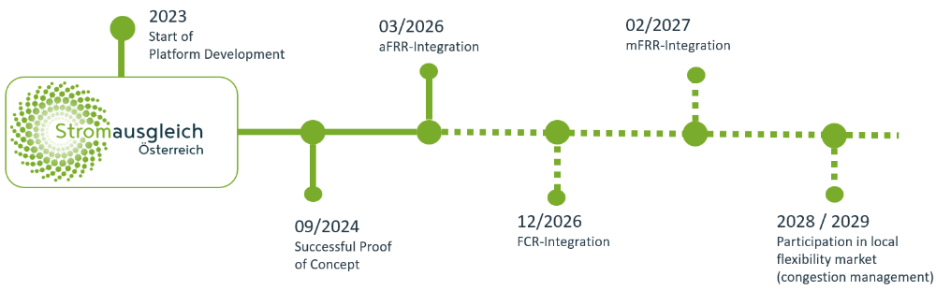
Roadmap
The Stromausgleich Österreich platform is designed to provide a single point of access to all relevant flexibility markets, giving participants the broadest possible range of market opportunities. The platform is continuously enhanced with new functionalities, additional market integrations, and expanded services to support the evolving needs of Austria's energy system and facilitate the integration of increasing flexibility into the power grid.
Questions & Answers (Q&A)
Stromausgleich Österreich is a centralized platform that enables flexible generation assets, energy storage systems, and other flexibility resources to participate in Austria’s balancing reserve markets. The platform provides a standardized technical interface to the balancing reserve markets and, in the future, to additional flexibility products. By offering a single point of access, it simplifies market participation, reduces technical complexity, and enables efficient, standardized connectivity across all supported markets.
The Stromausgleich Österreich platform is the Austrian implementation of the European Equigy Crowd Balancing Platform. Equigy is a joint initiative of several European transmission system operators (TSOs) that provides a standardized digital interface for integrating decentralized flexibility resources into balancing energy markets.
The Equigy initiative is supported by the following transmission system operators:
- Austrian Power Grid (APG) – Austria
- TenneT Germany – Germany
- TenneT Netherlands – Netherlands
- Terna – Italy
- TransnetBW – Germany
- Swissgrid – Switzerland
These six leading European TSOs jointly established Equigy and continue to drive the platform’s development, enabling a more flexible, digital, and integrated European electricity system.
The platform is designed for all flexibility providers—from aggregators and plant operators to energy suppliers—who want to use flexible generation assets, controllable consumption facilities, or energy storage systems to participate in Austria’s balancing power markets. It supports a wide range of applications, from large-scale asset portfolios and individual facilities to smaller aggregated pools of distributed resources, enabling market participation for flexibility providers of all sizes.
To participate, providers require a technically prequalified asset or portfolio of assets, a signed framework agreement for the relevant balancing product, and membership in a balancing group through which correction schedules can be processed. In addition, a secure data connection to the platform via a REST API is required to enable reliable communication and participation in the market processes.
The platform serves as the technical interface for accessing Austria’s balancing reserve markets. Currently, participants can already offer secondary balancing reserves (aFRR) in both power and energy markets. The integration of primary balancing reserves (FCR) and tertiary balancing reserves (mFRR) is planned for the near future, further expanding the range of flexibility products available through the platform.
In addition to secondary control reserves, primary control reserves (FCR) and tertiary control reserves (mFRR) will be introduced in the future. Furthermore, a new congestion management product is also planned.
In Austria, three types of control reserves are distinguished:
- Primary control reserve (power)
- Secondary control reserve (power & energy)
- Tertiary control reserve (power & energy)
Primary control reserve is available exclusively as a power product, whereas secondary and tertiary control reserves are available as both power and energy products.
Capacity Price
The capacity price remunerates the provision of control reserve capacity. It is paid to a facility or pool for making a specified amount of reserve capacity available for aFRR, mFRR, or FCR. This payment is made regardless of whether the reserved capacity is actually activated. Where applicable, participation in the energy auction and the ability to deliver the reserved capacity when called upon are prerequisites for receiving the capacity payment.
Energy Price
The energy price remunerates the actual delivery of balancing energy. It is specified in the energy auction and is paid only when a facility or pool is activated by the transmission system operator (TSO) to provide balancing energy. Compensation is based on the volume of energy actually delivered or absorbed during activation.
Participants must have a technically prequalified plant or pool of plants, be a member of a balancing group, and have a signed framework agreement with APG. In addition, they must establish a functioning technical connection to the platform, maintain a redundant internet connection, and ensure 24/7 operational availability. The current minimum bid size is 1 MW.
APG does not charge any direct fees for participation in the balancing reserve market. The admission process, including technical prequalification and the conclusion of the framework agreement, is free of charge. However, participants may incur individual costs, for example, related to technical connectivity, metering, communication infrastructure, or ensuring 24/7 operational readiness. These costs depend on the specific characteristics of the participant’s facilities and their internal organization.
Remuneration consists of a capacity price for making control reserve capacity available and, depending on the product, an energy price for the control energy actually activated. For aFRR and mFRR, both capacity and energy prices are remunerated, whereas for FCR, only the capacity price is paid. Participants submit their own bid prices, and contracts are awarded according to the merit order, i.e., based on the ranking of submitted offers by price. The actual revenue depends on the frequency and duration of activation, as well as the amount of control energy delivered.
The timeframe until a participant can submit its first balancing reserve bids depends on the successful completion of the technical prequalification process and the conclusion of the framework agreement. The overall duration is influenced by the resources available to the participant for completing the required steps, as well as APG’s ability to coordinate and schedule the necessary process activities. To ensure a smooth and efficient onboarding process, a joint timeline is established at the beginning of the participation process.
If you are interested in participating, the APG team will support you throughout the entire process, from technical prequalification to the conclusion of the framework agreement. The New Flexibility team (info@stromausgleich.at) coordinates the overall process and serves as the main point of contact.

Team New Flexibility